Product categories
- Brands (58)
- Easy Fresh (9)
- Face Fresh (37)
- Yusma (12)
- Hair Care (1)
- HAIR OILS (1)
- Shop by Concern (53)
- Acne & Pimples (22)
- Dark Circles (7)
- Dark Spots & Pigmentation (34)
- Dull Skin & Glow (37)
- Freckles (3)
- Open Pores & Texture (14)
- Sagging & Skin Firmness (8)
- Scars & Stretch Marks (4)
- Uneven Skin Tone (26)
- Wrinkles & Anti-Ageing (20)
- Shop by Skin Type (57)
- Acne-Prone Skin (13)
- Combination Skin (28)
- Dry Skin (19)
- Mature Skin (6)
- Oily Skin (17)
- Sensitive Skin (9)
- Skincare (57)
- Skincare ingredient (54)
- Aloe Vera (19)
- Alpha Arbutin (24)
- Amla (1)
- Azelaic Acid (4)
- Collagen (5)
- Cucumber (2)
- Glutathione (15)
- Glycolic Acid (3)
- Hyaluronic Acid (19)
- Kojic Acid (20)
- Milk & Honey (10)
- Niacinamide (38)
- Retinol (3)
- Rice Water (1)
- Rose Water (4)
- Salicylic Acid (4)
- Shea Butter (6)
- Tea Tree Oil (4)
- Vitamin C (17)
- Vitamin E (25)
- Uncategorized (0)
Rice Water
Rice water for skin is made by throwing the rice away. Rice powder is made by throwing the water away. They are opposite halves of the same grain, they behave in opposite ways, and almost every article and product online treats the two as if they were the same thing.
Getting that straight decides whether you should be buying something or making something, so it is worth two minutes.
Showing the single result
 Sale!
Sale!
What is actually in rice water
Mostly starch. When rice sits in water, the loose starch on the outside of each grain washes off, along with small amounts of water-soluble protein, a little inositol, and traces of B vitamins. That is the whole inventory. There is no tyrosinase inhibitor in it, no acid worth the name, and nothing that behaves like an active ingredient.
So what does it do? Starch in solution dries down as a very thin film. That film scatters light slightly, which reads as a softer, more even surface, and it holds a little water against the skin while it is there. Both effects are real. Both are temporary. That is the honest version of the benefits of rice water for skin, and it is more modest than the lists suggest.
Fermented rice water is a different liquid again. Left to ferment, some of the starch is converted, the pH drops, and organic acids appear. Much of what people credit to the rice in a fermented preparation is really that drop in pH doing what a mild acid does to the surface of skin.
How to use rice water for skin, without growing something in it
This is the part almost nobody covers, and here it matters more than most places, because an unpreserved starchy liquid left on a warm counter is a growth medium.
Rinse the rice first and pour that water away. It carries the surface dust and whatever the grain was stored with, and it is not the water you want.
Cover the rinsed rice with clean water and leave it for twenty to thirty minutes at room temperature. Longer does not extract more; it just gives bacteria a head start.
Strain it into a clean, sealed container and put it in the fridge immediately. Use it within three days and throw away anything that smells sour, looks cloudy in a new way, or has been out of the fridge for an afternoon.
Do not ferment it on a kitchen counter. In a climate that sits above thirty degrees for half the year, an open jar of starch water ferments in a direction you cannot control, and you will not be able to tell by looking which organisms won. If you want the acid, buy a formulated product with a stated acid in it instead.
Apply it on damp skin, then follow within a minute with a moisturiser. Rice water alone evaporates, and evaporating water takes some of your own with it.
Rice washes are a third thing again
A face rice wash usually means finely milled rice used as a soft physical polish, a format that has been part of Japanese and Korean routines for a very long time. It is not rice water and it is not what an ampoule contains. Face Fresh does not make one, and the closest thing in the range is our walnut shell and glycolic scrub, which is built for hands and feet rather than faces.
What is in the Face Fresh White Rice Ampoule
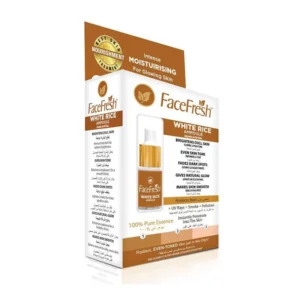
Rice powder, and it is last on the list of twelve. Above it sit sodium hyaluronate, a fragrance entry, glycerin, propylene glycol and a thickener.
Read plainly, that makes the white rice bottle a hydrating gel with rice powder in it, and the hydration is doing most of the work you can see. That is not a criticism. A well-made humectant gel is a genuinely useful thing to own, and the plumping effect on dull skin is real. It is simply not the thing the phrase rice water describes, and buying it expecting the other thing is how people end up disappointed.
One entry deserves a straight word. That list carries three separate preservatives, and one of them is methylisothiazolinone, which is a well documented contact allergen and is not permitted in leave-on cosmetics in the European Union. This is a leave-on product. If you have ever reacted to a preservative, or you know your skin is easily provoked, read that list before you buy this one and choose the hyaluronic acid ampoule instead, which is preserved differently.
The honest limits
Rice water does not whiten skin. It has no effect on melanin production. The brightness people report is the light-scattering film and better hydration, and both wash off.
It does not treat acne, fade dark spots or shrink pores. If a page tells you otherwise, count the mechanisms it offers. There usually are none.
It has almost no research behind it as a topical. Most of the rice research that gets cited concerns rice bran oil or fermented filtrates from specific strains, which are different materials with different compositions.
Homemade rice water has no preservative. Three days in a fridge, then bin it, without exception.
So should you buy or make?
Make it, if what you want is the classic rinse. It costs nothing, it takes half an hour, and no bottled version of it is meaningfully better than the one in your kitchen.
Buy a formulated product, if what you actually want is lasting hydration and a smoother surface that survives the morning. That is a humectant job, and it needs a preserved formula built for it.
If dullness rather than dryness is the problem, start with the glow page, which sorts our products by what is causing the dullness rather than by which grain is on the label.
Frequently asked questions
Is rice water the same as rice powder?
No. Rice water is the liquid you keep after discarding the grain. Rice powder is the milled grain itself. One is a starchy solution, the other an absorbent solid, and they do different jobs.
Does rice water lighten skin?
No. It contains nothing that acts on melanin. The brightness people notice is a thin starch film scattering light plus better surface hydration, and both rinse away.
How long does homemade rice water keep?
Three days in a sealed container in the fridge. It has no preservative in it, so anything older, warmer or sour-smelling goes down the sink.
Should I ferment my rice water?
Not in this climate, not on a counter. You cannot control which organisms take hold above thirty degrees. If you want the acidity, buy a product with a stated acid in it.
Can I leave rice water on overnight?
You can, but there is little point. It dries in minutes and the film does not survive a pillow. Apply it, then seal it in with a moisturiser within a minute.
Does the White Rice Ampoule contain rice water?
No, it contains rice powder, listed last of twelve ingredients. Most of what it delivers comes from the hyaluronate and glycerin above it, which is a hydrating job rather than a rice one.
Is rice water safe for sensitive skin?
The homemade rinse is very mild, provided it is fresh. The bigger question with any bottled version is the preservative system, which is where reactions to gentle-sounding products usually come from.
Can I use rice water on my hair?
People do, and the same rules apply: fresh, refrigerated, three days. Starch left in hair can feel stiff, so rinse it out rather than leaving it in.