Product categories
- Brands (58)
- Easy Fresh (9)
- Face Fresh (37)
- Yusma (12)
- Hair Care (1)
- HAIR OILS (1)
- Shop by Concern (53)
- Acne & Pimples (22)
- Dark Circles (7)
- Dark Spots & Pigmentation (34)
- Dull Skin & Glow (37)
- Freckles (3)
- Open Pores & Texture (14)
- Sagging & Skin Firmness (8)
- Scars & Stretch Marks (4)
- Uneven Skin Tone (26)
- Wrinkles & Anti-Ageing (20)
- Shop by Skin Type (57)
- Acne-Prone Skin (13)
- Combination Skin (28)
- Dry Skin (19)
- Mature Skin (6)
- Oily Skin (17)
- Sensitive Skin (9)
- Skincare (57)
- Skincare ingredient (54)
- Aloe Vera (19)
- Alpha Arbutin (24)
- Amla (1)
- Azelaic Acid (4)
- Collagen (5)
- Cucumber (2)
- Glutathione (15)
- Glycolic Acid (3)
- Hyaluronic Acid (19)
- Kojic Acid (20)
- Milk & Honey (10)
- Niacinamide (38)
- Retinol (3)
- Rice Water (1)
- Rose Water (4)
- Salicylic Acid (4)
- Shea Butter (6)
- Tea Tree Oil (4)
- Vitamin C (17)
- Vitamin E (25)
- Uncategorized (0)
Amla
There is no such thing as a pure amla hair oil, and that is not a criticism of anyone selling one. Amla is a fruit. Fruits of this kind do not give oil, and there is no commercial amla kernel being pressed anywhere to make the bottles on that search results page.
Every amla oil is amla put into something else. Which means the question worth asking is not how pure it is. It is what the something else happens to be.
Showing the single result
 Sale!
Sale!
What amla actually is
Amla is the Indian gooseberry, Phyllanthus emblica, a small sour green fruit used in Ayurvedic practice for a very long time. Fresh, it is roughly eighty per cent water. What is left is unusually rich in vitamin C and in tannins, and it is those, plus a set of polyphenols, that the interest is about.
To get any of that into a bottle you either dry and powder the fruit, make a water or alcohol extract, or steep the dried fruit in an oil and strain it. All three end up as amla in a carrier. On an ingredient list this shows up as Amla Extract or Emblica Officinalis Fruit Extract, sitting somewhere below whatever the carrier is.
The carrier is ninety per cent of the bottle
Three carriers dominate, and they behave differently enough that the choice matters more than the amla does.
Mineral oil, listed as Paraffinum Liquidum, coats the hair shaft without entering it. It does not go rancid, it gives strong shine and slip, and it protects against the friction that snaps hair. It is also difficult to wash out fully, and it does nothing for the scalp underneath. The best selling amla oils in the world are built this way, including ours.
Coconut oil is the one carrier that genuinely penetrates the hair shaft rather than sitting on it, which is why it reduces protein loss during washing. It is heavier, it can look greasy on fine hair, and it turns solid below about twenty-four degrees, so a bottle kept in an air-conditioned bathroom here will often arrive at your hands as a paste.
Sesame oil is thinner, absorbs faster and has a distinct smell some people dislike. It oxidises faster than the other two, which brings you back to buying small bottles and finishing them.
What amla itself has evidence for
Honestly, less than the marketing implies. Most of the work is laboratory and animal research, looking at effects on five alpha reductase and on the hair follicle cycle. Human trials on amla applied to a scalp are thin on the ground.
That does not make it useless. It makes it traditional, plausible and unproven, which is a fair description of a great deal of hair care. If someone quotes you a percentage of hair regrown from an amla oil, ask where the number came from.
Our own bottle's page goes through what a coating oil realistically delivers and where the amla sits on the list, and that argument is not repeated here.
The greying claim, straight
Amla's oldest reputation is for keeping hair dark, and it is worth separating two different things.
Deposited colour is real. Many amla oils, ours included, also contain henna extract, and henna stains the hair shaft. Over repeated use that reads as darker hair. It fades with washing and it is a dye effect, not a biological one.
Restored pigment is not on offer. Grey hair happens when the pigment cells in a follicle stop producing melanin, and no oil applied to the outside of a hair shaft reaches or restarts them. Anything promising to reverse grey is promising something an oil cannot do.
What amla oil will not fix
Dandruff. Flaking is usually driven by a yeast feeding on scalp oils, so adding more oil is at best neutral and can make a flaky scalp worse. An anti-fungal shampoo is the tool for that job.
Hair loss with a medical cause. Thyroid problems, iron deficiency, post-partum shedding and pattern loss all need diagnosis rather than oil, and months spent oiling are months not spent treating.
A rough, chemically processed length. Oil improves how damaged hair behaves. It does not repair it, because hair above the scalp is not living tissue and cannot heal.
Which Face Fresh product to choose
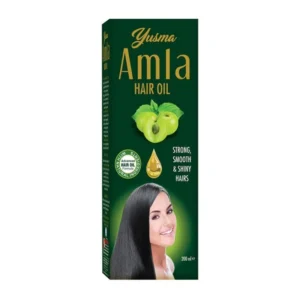
The two hundred millilitre Yusma bottle is a mineral oil amla oil with henna, tocopherol acetate and BHT, built the same way as the classic Indian oils it sits beside on a shelf. It suits people who want shine, slip and less breakage, and who use an oil before washing rather than leaving it in.
It does not suit anyone who wants a plant-oil-only product, anyone treating a flaky scalp, or anyone hoping to reverse grey. We would rather say that here than have you find out over three months.
It is the only thing on our hair care shelf at the moment, and the rest of that line sits on the Yusma brand page. If you want the vitamin E story rather than the amla one, the vitamin E page explains what tocopherol acetate is doing in a bottle like this, which is mostly protecting the oil rather than your scalp.
Frequently asked questions
Is there such a thing as 100% pure amla oil?
Not really. Amla has no pressable kernel oil, so every product is amla extracted or steeped into a carrier. A bottle labelled pure is describing the amla, not the oil around it.
What is the best carrier for an amla oil?
Coconut if you want penetration and do not mind weight, mineral oil if you want shine and protection from breakage, sesame if you want something light. There is no single right answer.
Does amla oil regrow hair?
There is laboratory and animal evidence pointing that way and very little human evidence. Treat it as traditional and plausible rather than proven, and be sceptical of any percentage quoted at you.
Does amla oil turn grey hair black again?
No. Any darkening comes from henna or added colour staining the outside of the hair, and it fades. Nothing applied to a hair shaft can restart pigment cells in the follicle.
Should I leave amla oil in or wash it out?
Wash it out. A mineral oil base coats rather than absorbs, so left in it reads as greasy on most hair. An hour before shampooing, once or twice a week, is the usual routine.
Can I use amla oil on my skin?
You can, but there is no reason to. A mineral oil base is occlusive and will suit dry elbows and shins; on a face it is heavy and the amla adds nothing you cannot get better elsewhere.
Will amla oil help my dandruff?
Probably not. Flaking is usually a yeast feeding on scalp oils, so adding oil does not address the cause. An anti-fungal shampoo is the right first step.
Why does the Yusma oil list mineral oil first?
Because it is the carrier, and the carrier is most of any amla oil including the market leaders. The product page explains what that construction does and does not deliver.