Product categories
- Brands (58)
- Easy Fresh (9)
- Face Fresh (37)
- Yusma (12)
- Hair Care (1)
- HAIR OILS (1)
- Shop by Concern (53)
- Acne & Pimples (22)
- Dark Circles (7)
- Dark Spots & Pigmentation (34)
- Dull Skin & Glow (37)
- Freckles (3)
- Open Pores & Texture (14)
- Sagging & Skin Firmness (8)
- Scars & Stretch Marks (4)
- Uneven Skin Tone (26)
- Wrinkles & Anti-Ageing (20)
- Shop by Skin Type (57)
- Acne-Prone Skin (13)
- Combination Skin (28)
- Dry Skin (19)
- Mature Skin (6)
- Oily Skin (17)
- Sensitive Skin (9)
- Skincare (57)
- Skincare ingredient (54)
- Aloe Vera (19)
- Alpha Arbutin (24)
- Amla (1)
- Azelaic Acid (4)
- Collagen (5)
- Cucumber (2)
- Glutathione (15)
- Glycolic Acid (3)
- Hyaluronic Acid (19)
- Kojic Acid (20)
- Milk & Honey (10)
- Niacinamide (38)
- Retinol (3)
- Rice Water (1)
- Rose Water (4)
- Salicylic Acid (4)
- Shea Butter (6)
- Tea Tree Oil (4)
- Vitamin C (17)
- Vitamin E (25)
- Uncategorized (0)
Collagen
Collagen boosting skin care products and products that contain collagen are two different claims, and most labels use them as though they were one. The first group tries to get your skin to build more of its own. The second puts collagen on top of your skin, where it behaves as a very good moisturiser and nothing more.
Both sit on the same shelf at similar prices. This page explains which is which, what genuinely signals your skin to make collagen, and how to read a label so you stop paying for the word.
Showing all 5 resultsSorted by popularity
 Sale!
Sale!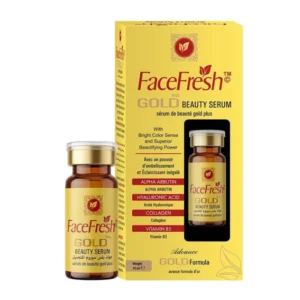 Sale!9.99$
16.99$41% OffAdd to cart This product has multiple variants. The options may be chosen on the product page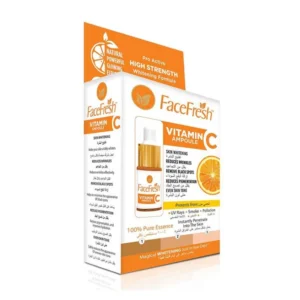 Sale!
Sale!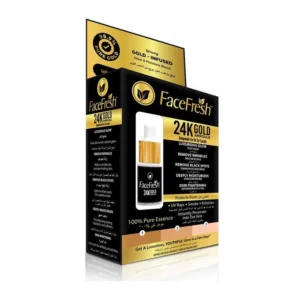 Sale!
Sale!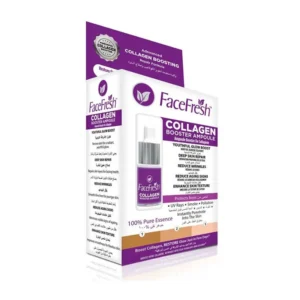 Sale!
Sale!
What collagen is, and where yours went
Collagen is the structural protein that makes up most of the dry weight of your dermis. Think of it as scaffolding: bundled fibres that hold skin taut, with elastin threaded through for recoil and hyaluronic acid filling the spaces between.
You start losing it in your twenties, slowly and continuously. But the loss is not evenly caused. Ultraviolet light does far more damage than age alone, which is why the inside of your upper arm at fifty looks decades younger than the back of your hand. Smoking, poor sleep and repeated inflammation add to it. For women, the drop around menopause is steeper than anything a cream is competing with.
That matters commercially, because it tells you where the leverage is. Most of what you can still influence is damage you have not done yet.
Why applied collagen cannot become your collagen
Collagen is an enormous molecule. Intact, it is far too large to cross the outer layer of skin, and even hydrolysed into smaller fragments it is not reassembled into fibres underneath. This is settled and uncontroversial, and every honest brand knows it.
That does not make it useless. Collagen on the surface is genuinely good at holding water against the skin, which softens the look of fine lines for a few hours and gives that immediate smooth, plumped feel. It is a humectant with an impressive name. Our own Collagen Booster Ampoule carries a large amount of it and its product page works through exactly what that quantity means in practice.
The trouble is only that a humectant effect and a structural effect look similar in the mirror at nine in the morning, and completely different after two years.
What actually boosts collagen
Four things have real evidence behind them, and only one of them is a jar.
- Sun protection. Daily, all year, on the face and the backs of the hands. Nothing else you can buy comes close, because preventing breakdown outperforms encouraging synthesis by a wide margin.
- Retinoids. Retinol and its prescription relatives are the most studied topical route to new collagen. Our Retinol Ampoule page covers how to use one without the peeling that makes most people quit.
- Vitamin C. Your body cannot build collagen without it — it is a required cofactor in the enzymatic step that stabilises the fibre. There is more on which forms survive in a bottle on the vitamin C ingredient page.
- Peptides. Short chains such as palmitoyl tripeptide-1 and palmitoyl tetrapeptide-7 resemble the fragments left behind when collagen breaks down, and the theory is that skin reads them as a prompt to rebuild. The evidence is real but modest, and much of it is manufacturer-run. Worth having, not worth paying a premium for.
Notice what is not on that list: collagen.
The substitution test
Here is a two-second way to judge any product sold as collagen-boosting. Cross out the word collagen everywhere it appears — the front of the pack, the product name, the ingredient list — and read what is left.
If a retinoid, a vitamin C derivative or a peptide is still standing, the product has a mechanism. If the page goes blank, you are buying a moisturiser with a marketing department.
Run it on anything, including ours. The Gold Plus Beauty Serum survives the test on peptide and tone grounds but not on collagen grounds, and its own page says as much rather than pretending otherwise.
Collagen patches, sheet masks and what they really do
Collagen patches for skin — the hydrogel crescents for under the eyes, the sheet masks, the lip strips — work, briefly, and not for the reason printed on the sachet.
A patch does two things. It holds a humectant solution against skin for twenty minutes without letting it evaporate, which is far more contact than a serum gets. And the film itself occludes, so water moving up from the lower layers collects at the surface instead of leaving. The result is genuinely plumper, smoother skin for a few hours. It is hydration under a lid.
The collagen in the gel is doing the same surface job it does anywhere else. Use patches before an event, not as a treatment, and do not expect the effect to accumulate.
Can collagen tighten loose skin?
Collagen for skin tightening is where the gap between the promise and the biology is widest, so it is worth being precise about what people mean by loose.
Skin that feels crepey, thin and finely lined on the cheek or forearm is a surface-quality problem, and surface quality does respond to topicals over months. Skin that has descended — a softened jawline, a heavier fold from nose to mouth, hooding at the outer eye — is not a skin problem at all. It is fat pad movement, ligament laxity and bone remodelling underneath. No cream reaches any of that, and nobody selling you one believes it does.
The skin firmness page sorts the two properly, including the honest point at which the answer stops being a product.
Which Face Fresh product fits
None of these is a collagen-boosting product in the strict sense, and we would rather say so than dress one up.
- For the immediate plumped effect, and the largest quantity of collagen in the range, the Collagen Booster Ampoule. Buy it for how skin looks and feels the same day.
- For the vitamin C cofactor, the Vitamin C Ampoule, which uses a stable derivative that does not oxidise in the bottle.
- For the retinoid route — the strongest topical evidence there is — the Retinol Ampoule, two or three nights a week to begin with.
- For peptides in a cheap trial size, the Fairness Serum, which carries Matrixyl 3000 alongside its tone actives.
If you are choosing one, choose the retinol, and put sunscreen in front of it. The honest limitation on this whole page is that the single most effective collagen-preserving step available to you is a broad-spectrum SPF worn daily, and Face Fresh does not currently make one with a tested rating. Several of our creams contain a UV filter; none of them is a sunscreen and none should be used as one.
FAQs
Does collagen cream actually work?
It works as a moisturiser. Collagen molecules are far too large to reach the layer where your own collagen sits, so a cream softens the look of lines rather than rebuilding structure.
Is a collagen serum for skin worth buying at all?
Yes, if you buy it for hydration and same-day smoothness. Our Collagen Booster Ampoule is a good example. It is poor value if you expect it to add structural collagen.
Do collagen supplements work better than creams?
The oral evidence is stronger than the topical evidence, though most trials are industry-funded and short. Digestion breaks collagen into amino acids your body can send anywhere, not just to skin.
How long before a collagen-boosting routine shows anything?
With a retinoid used consistently, most people notice texture change at eight to twelve weeks and line change closer to six months. Anything faster than that is hydration, not structure.
Do clinic treatments boost collagen more than creams?
Considerably, yes. Microneedling, fractional lasers and radiofrequency provoke a repair response no topical matches. They are also more expensive, need a qualified operator and carry real downtime.
Why is collagen listed on so many Face Fresh products?
Because it is an effective and pleasant humectant, and it earns its place on that basis. It appears in the Collagen Booster, Vitamin C and 24K Gold ampoules and the Gold Plus serum.
Does drinking water boost collagen?
No. Hydration affects how plump skin looks on any given day, which is worth having, but it has no effect on the rate at which your body builds or loses collagen fibres.
At what age should I start?
Sun protection from now, whatever your age. A retinoid is usually worth adding in your late twenties or thirties, though there is no threshold at which it suddenly becomes necessary.
If you want the same-day effect, start with the Collagen Booster Ampoule. If you want the slow one, start with the Retinol Ampoule and wear sunscreen over it.