


Quick answer: The best cream for fair skin without bleaching fades dark spots and evens your tone with gentle, proven ingredients such as alpha arbutin, kojic acid, niacinamide, licorice and vitamin C, and you wear it with sunscreen every day. It prints every ingredient on the pack, and none of them is hydroquinone, mercury or a steroid like clobetasol. Our pick for most skin types is Face Fresh Fairness Cream.
If you are looking for a cream for fair skin without bleaching, you probably want two things at once: brighter, more even skin, and the peace of mind that you are not harming it. That is exactly the right goal, and it is more achievable than the miracle claims on many jars suggest.
Here is the honest part first. No cream can change the skin colour you were born with, and a product that promises to do it fast is usually doing it with bleach. What a good fair skin cream can do is fade the dark spots, sun tan, patches and dullness that sit on top of your natural tone, so your skin looks clear, even and bright.
This guide explains what bleaching really is and its side effects, how to spot a bleaching cream from its label, which ingredients work safely instead, and how to choose the right fairness cream for your skin type.
Brightening vs bleaching: what is the difference?
Brightening means fading extra pigment (dark spots, tan, marks left by pimples) and clearing dull surface cells, so your own skin tone shows evenly. It works gradually and stops at your natural colour.
Bleaching means forcing your skin’s pigment production down hard, or thinning the skin itself, to make it lighter than it naturally is. It often works quickly, and that speed is exactly what causes the damage. If you want to go deeper, our guide to what “brightening” means on a skincare label covers the wording brands use.
What bleaching creams contain, and their side effects
Three ingredients cause most of the harm:
- Mercury. It can appear on a label as calomel, mercurous or mercuric chloride, or mercurio. Health authorities link it to kidney damage, nervous-system effects and skin rashes, and it is a risk to unborn babies. Many countries ban it, yet it still turns up in creams sold online and in markets.
- Strong hydroquinone. It is not permitted in cosmetics in the EU and is prescription-only in many countries. Used for long periods without a doctor, it can cause exogenous ochronosis, a blue-black darkening that is very hard to reverse.
- Potent steroid creams such as clobetasol propionate or betamethasone. Lightening is a side effect, not their purpose. Long use thins the skin and can bring stretch marks, acne, easy bruising and darker patches when you stop.
So the usual skin bleaching side effects are thin, fragile skin, patchy colour, dark knuckles and elbows, burning, and skin that reacts to almost everything. Repairing that damage takes far longer than causing it.
How to tell if a cream contains bleach
- There is no full ingredient list, no manufacturer name or no batch number.
- The label lists hydroquinone, clobetasol, betamethasone, calomel, mercurous, mercuric or mercurio.
- It promises “permanent whitening” or visible change in seven days.
- Your face lightens fast while your knuckles, elbows or the skin around your eyes get darker.
- It burns, peels or turns red within the first few days.
If any of these apply, stop using it and ask a pharmacist or dermatologist.
Is a toning cream the same as a bleaching cream?
Sometimes. “Toning” should mean evening out your tone, but in many markets it has become a softer word for lightening, and some toning creams contain the same bleaching agents. The front of the pack will not tell you which kind you have. The ingredient list will.
Hydroquinone alternatives: ingredients that brighten without bleaching
The best cream for fair skin without hydroquinone relies on ingredients that calm pigment production or clear dull surface cells. None of the ones below bleaches your skin.
| Ingredient | What it does | Good to know |
|---|---|---|
| Alpha arbutin | Slows tyrosinase, the enzyme that makes melanin | EU safety experts consider it safe up to 2% in face creams |
| Kojic acid (kojic dipalmitate) | Also slows tyrosinase | The dipalmitate form stays stable in creams |
| Niacinamide (vitamin B3) | Slows the transfer of pigment to surface skin cells | 5% niacinamide reduced hyperpigmentation within 4 weeks in a published clinical study |
| Licorice extract | Fades spots and calms redness | Plant-derived and gentle |
| Vitamin C (ascorbyl glucoside) | Antioxidant that lifts dullness | Works gradually, over weeks |
| Zinc oxide, titanium dioxide | Reflect UV light | No brightening cream keeps up without sun protection |
Alpha arbutin vs hydroquinone: the two are chemically related, but alpha arbutin is much gentler, works more slowly and is accepted in cosmetics at controlled levels, while hydroquinone at strength is a medicine. Does kojic acid bleach skin? No. It reduces new pigment being made; it does not strip the colour you have. That is why a kojic acid and arbutin cream is a sensible place to start if you want brighter skin without bleach. For a closer look at serums, see does a whitening serum bleach your skin?
You will also see glutathione in brightening creams. It is a strong antioxidant, but the evidence for it brightening skin when applied as a cream is still limited, so treat it as a supporting ingredient rather than the main one.
Our pick: Face Fresh Fairness Cream
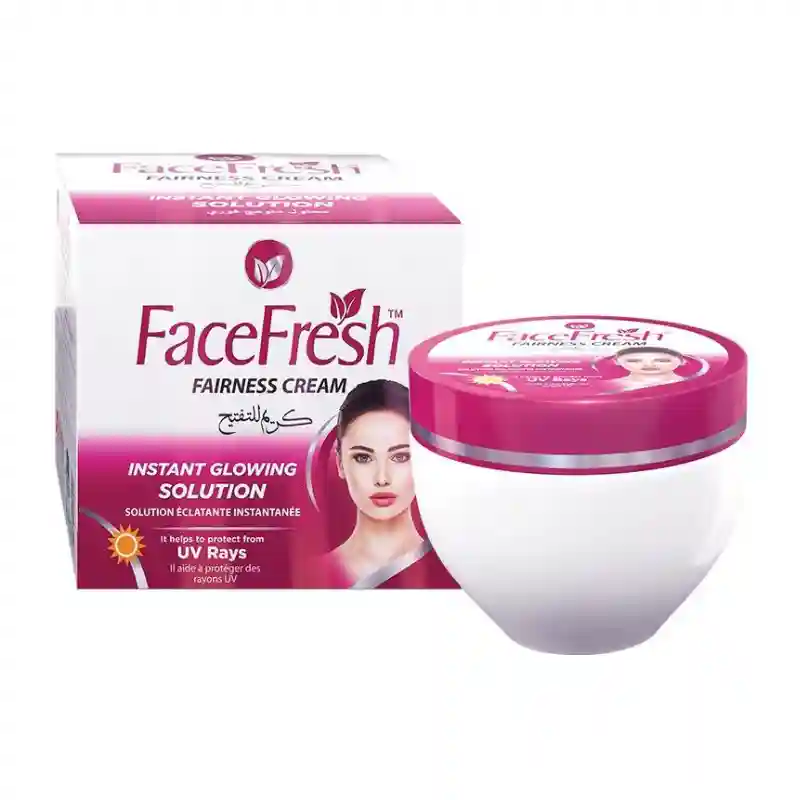
If you want one fairness cream for the face that brightens without bleaching, Face Fresh Fairness Cream is where we would start. It is built around the same hydroquinone alternatives described above, and every ingredient is printed on the pack.
What is inside: alpha arbutin, kojic dipalmitate and niacinamide to fade spots and tan; licorice extract to calm the skin; vitamin E and a vitamin C derivative (ascorbyl glucoside) for softness and glow; avocado oil, beeswax and glycerin to keep moisture in; and zinc oxide, titanium dioxide and octyl methoxycinnamate, which filter UV light. Hydroquinone, mercury and steroids are not on its ingredient list.
Who it suits: normal, combination and dry skin with uneven tone, dark spots or dullness. It works as a fairness cream for daily use, morning and night.
Good to know before you buy:
- It contains UV filters, but no SPF number is stated, so still apply a separate sunscreen when you are outdoors.
- It contains parabens and fragrance. If your skin is sensitive, patch test first.
- It is a fairly rich cream. On very oily skin, use a pea-sized amount and see the oily-skin tips below.
- Sizes: a 70 g jar and a 25 g travel tube.
How to use it: cleanse, pat your face dry, then smooth a pea-sized amount over the face and neck. In the morning, follow with sunscreen.
Best fairness cream for dry skin: Fairness Beauty Cream 23g
If your skin runs dry, Face Fresh Fairness Beauty Cream 23g is the richer option. It pairs glutathione, alpha arbutin, niacinamide and kojic dipalmitate with avocado oil, beeswax, lanolin alcohol and vitamin E. That extra cushion helps in air-conditioned Gulf offices and in the dry Harmattan months. Skip it if you are allergic to lanolin.
For stubborn spots: add Fairness Serum
Face Fresh Fairness Serum layers alpha arbutin and niacinamide with vitamin E and a hyaluronate moisturiser under your cream. Use a few drops before your cream, at night to start.
Fairness cream for oily skin
Oily skin still needs moisture, but a heavy layer can feel greasy in heat. Use a pea-sized amount of Fairness Cream at night only, wash in the morning with Fairness Face Wash (it contains niacinamide), and use a light, oil-free sunscreen by day. If you break out, cut back to every other night.
| Your skin | Start with | When |
|---|---|---|
| Normal or combination, uneven tone | Fairness Cream | Morning and night |
| Dry or dull | Fairness Beauty Cream 23g | Night, or morning and night |
| Oily | Fairness Cream, a thin layer | Night only |
| Stubborn dark spots | Add Fairness Serum | Under your cream, at night |
The best fairness cream for women, and for men
Skin brightens the same way whatever your gender, so the best fairness cream for women is also a good choice for men. The difference is usually skin type: men’s skin is often oilier, so the thin-layer, night-only approach above tends to suit better. Shaving can also irritate, so apply your cream a few minutes after shaving rather than straight away.
Day cream or night cream for fairness?
Both have a place. In the day, your fairness cream should sit under sunscreen, because the sun keeps making new pigment every hour you go without it. At night your skin is not fighting UV, which makes it the best time for richer creams and serums. If you only want one product, Fairness Cream works for both; if you want a dedicated night cream for fairness on dry skin, use Fairness Beauty Cream after dark.
How to get brighter skin without bleaching: a simple routine
- Morning: wash with a gentle cleanser, apply your fairness cream, then sunscreen SPF 30 or higher. Reapply sunscreen if you are outdoors for long.
- Evening: cleanse, apply serum if you use one, then your cream.
- Patch test first: dab a little behind your ear or on your inner arm and wait 24 to 48 hours.
- Change one thing at a time, so you know what is working.
Sunscreen is the step most people skip, and it decides whether your results last.
How long does a fair skin cream take to work?
Your skin renews itself roughly every four weeks, more slowly as you get older. Expect dullness to lift in 3 to 4 weeks and dark spots to fade over 6 to 8 weeks. Older marks and melasma can take three months or more and may need a dermatologist.
If you see nothing after 12 weeks of daily use with sunscreen, change your approach. If a cream changes your skin in seven days, be suspicious of it.
Can you get fair skin permanently?
Not in the sense of changing your natural colour; that is set by your genes. What you can keep is the result: once spots and tan have faded, daily sunscreen stops most of them coming back. Any cream that promises permanent whitening is either exaggerating or bleaching.
Skin lightening on dark skin: go gently
Deeper skin tones make more pigment and react to irritation by making even more, which leaves dark marks after pimples, cuts or harsh products. It is also the skin type where hydroquinone-related ochronosis is seen most. So if you have darker skin, choose gentle ingredients, avoid strong peels and scrubs, introduce one product at a time and protect from the sun every day. Slow and steady gives a far better result than fast and patchy.
Buying in Nigeria, Ghana, India and the Gulf
The rules are the same wherever you live. If you are searching for the best face cream for fair skin in Nigeria, a safe skin whitening cream in India, or a pomade for fair skin without bleaching, look for a full ingredient list, none of the warning words above, and a seller you trust.
Face Fresh ships from the UAE to 233 destinations, usually in 3 to 5 working days. Delivery is free inside the UAE; to most countries it is $35, and free once your order passes $99. You can check the charge for your country on our worldwide shipping page.
Frequently asked questions
Which cream is best for fair skin without bleaching?
One that fades spots with ingredients like alpha arbutin, kojic acid and niacinamide, lists every ingredient, and suits your skin type. For most people that is Face Fresh Fairness Cream; for dry skin, Fairness Beauty Cream 23g.
Is there a skin whitening cream without side effects?
No cream is free of side effects for every person. Gentle brightening creams rarely cause more than mild tingling at first. Redness, burning or peeling that does not settle in a few days means stop. Creams that lighten quickly with bleach carry the serious side effects described above.
Is it safe to use a fairness cream every day?
Yes, brightening creams like Fairness Cream are made for daily use. Use sunscreen alongside it, and pause if your skin becomes irritated.
Is a natural face cream for fair skin always safer?
Not automatically. “Natural” or “herbal” on the front tells you nothing about safety, and some herbal creams have been found to contain mercury or steroids. The full ingredient list is what matters.
Can I use a face cream on my body?
Face creams are made and priced for small areas. For arms and legs, a body product such as Face Fresh Fairness Lotion spreads further and suits body skin.
Can I use a brightening cream while pregnant?
Ask your doctor first before starting any new brightening product during pregnancy.
Where to start
Pick one cream that suits your skin, wear sunscreen every day, and give it eight weeks. For most people, Face Fresh Fairness Cream is the simplest place to begin. You can compare every option in our creams collection, or browse by concern: uneven skin tone and dull skin.
Sources
- World Health Organization, Mercury in skin lightening products (2019)
- Minnesota Department of Health, Skin lightening products
- European Commission, Scientific Committee on Consumer Safety, Safety of alpha-arbutin and beta-arbutin in cosmetic products (2023)
- Hakozaki T. et al., The effect of niacinamide on reducing cutaneous pigmentation and suppression of melanosome transfer, British Journal of Dermatology (2002)